
14 août 2019 | Local, Aérospatial

Red Arrows rock Gatineau-Ottawa

by Eric Dumigan

Under blue skies, the team wowed thousands in a special one-day edition of Aero Gatineau-Ottawa. The Red Arrows, who last performed in North America more than a decade ago, are conducting an 11-week North American tour that “aims to promote the best of British and deepen partnerships with close friends and allies.” The contingent includes 108 people, 12 Red Arrows Hawk T1 aircraft and one Atlas A400M RAF transport aircraft.

In their 55th season, the Red Arrows will travel coast to coast across North America, conducting aerobatic displays, flypasts and ground engagements.

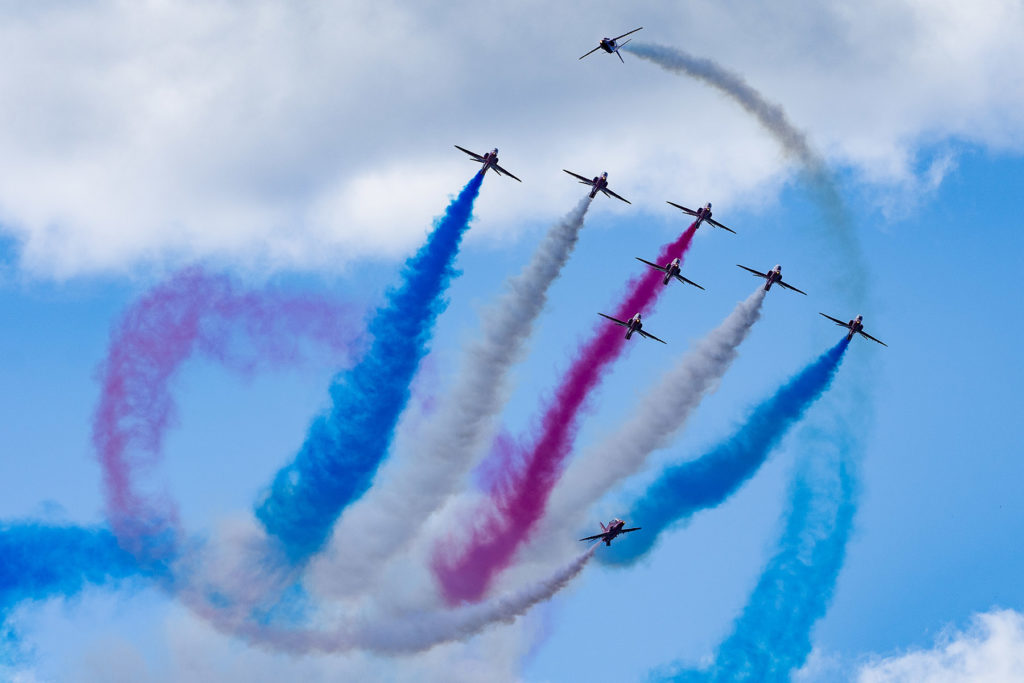
The Red Arrows use a mix of red, white and blue smoke during their performances to enhance visual presentation. Eric Dumigan Photo

The Red Arrows use a mix of red, white and blue smoke during their performances to enhance visual presentation. Eric Dumigan Photo

The team's leader, Martin Pert, leads the nine-plane formation in a series of manoeuvres with formations that salute the 50th anniversary of the Apollo mission; the Concorde, the world's only supersonic commercial aircraft; the Second World War Lancaster bomber; and the Tornado, a multi-roll strike aircraft that was retired from the RAF in 2019. The team uses red, white and blue smoke to enhance its visual presentation.

The Red Arrows were formed in 1965 and have performed over 5,000 displays in 57 countries around the world. The Folland Gnat was replaced in 1980 with their current aircraft, the BAE Systems Hawk T1 trainer. The Hawk is a standard military two-seat advanced trainer with a tweaked engine to allow for faster response times.

The Red Arrows performed a flypast in Halifax this past weekend and will perform in Toronto on Labour Day weekend, and in Victoria and Vancouver between September 24 and 27.

Aero Gatineau-Ottawa will host a full airshow from Sept. 6 to 8, featuring the U.S. Air Force F-35 Lightning II Demo Team.

https://www.skiesmag.com/news/red-arrows-rock-gatineau-ottawa/

Sur le même sujet

  • Le gouvernement du Canada attribue un contrat de services de soutien pour la Station des Forces canadiennes (SFC) Alert au Nunavut

    3 octobre 2022 | Local, Terrestre

    Le gouvernement du Canada attribue un contrat de services de soutien pour la Station des Forces canadiennes (SFC) Alert au Nunavut

    Le 3 octobre 2022 – Ottawa – Défense nationale / Forces armées canadiennes À l'issue d'un processus concurrentiel, équitable, ouvert et transparent, Services publics et Approvisionnement Canada a attribué, au nom de la Défense nationale, un contrat de 122 millions de dollars (taxes inclues) à la société Nasittuq Corporation d'Ottawa, en Ontario, en vue de fournir des services de soutien à la SFC Alert au Nunavut pour une période initiale de huit ans et demi. La SFC Alert est une station militaire située au Nunavut, à l'extrémité nord-est de l'île d'Ellesmere, la plus septentrionale des îles de l'archipel Arctique canadien. Environnement et Changement climatique Canada y opère une station météorologique, laquelle est une installation militaire qui n'est toutefois pas ouverte au public. Le contrat avec la société Nasittuq Corporation couvre tous les services de soutien du site de la SFC Alert, y compris les logements, les services d'alimentation, l'entretien et l'utilisation des terrains et des routes (y compris la piste d'aérodrome), les centrales électriques, les b'timents, les génératrices, les réseaux d'approvisionnement en eau et de traitement des eaux usées, les systèmes d'alarme incendie, les réservoirs de stockage des carburants ainsi que l'exploitation d'une carrière. Nasittuq Corporation s'occupera également de l'entretien et des travaux majeurs de réfection de quelque 90 b'timents de la station – dont 19 grandes structures. Les services offerts dans le cadre du contrat aideront à fournir au personnel des milieux de travail bien entretenus qui appuient l'efficacité des opérations de base, ainsi que le nécessaire pour vivre et travailler dans l'environnement arctique. La Politique sur le contenu canadien ainsi que les obligations du Canada en vertu des Ententes sur les revendications territoriales globales, notamment la récente Directive sur les marchés de l'État dans la région du Nunavut du Secrétariat du Conseil du Trésor, s'appliquent à ce contrat. https://www.canada.ca/fr/ministere-defense-nationale/nouvelles/2022/10/le-gouvernement-du-canada-attribue-un-contrat-de-services-de-soutien-pour-la-station-des-forces-canadiennes-sfc-alert-au-nunavut.html

  • 5 ways the U.S. election result could impact Canada

    13 octobre 2020 | Local, Aérospatial, Naval, Terrestre, C4ISR, Sécurité, Autre défense

    5 ways the U.S. election result could impact Canada

    CBC News Trump and Biden have different ideas about trade, defence, China, energy and migration The fallout from an American election touches countries around the world — starting with its neighbours next door. And on some issues with clear implications for Canada, Joe Biden and Donald Trump offer contrasting positions. The CBC has explored a few of these topics, in stories summarized here with links to a deeper dive on each. Here are five areas where the Nov. 3 presidential election might affect Canada. Energy and the environment There are striking differences between the candidates. Trump promises more oil drilling, more pipelines — and less regulation. Joe Biden, on the other hand, says he'd cancel Trump's permit for the Keystone XL pipeline from Canada. Biden wants to invest massively in clean energy; rejoin the Paris Accord; and, finally, name, shame and potentially punish countries with green tariffs if they fail to cut emissions. International trade Some irritants would remain no matter who wins. For instance, Biden promises more Buy American policies and perennial disputes like softwood lumber would not disappear. But Biden says he'd drop some of Trump's most aggressive moves against allies, like the steel and aluminum tariffs based on alleged national-security grounds. He has also hinted he might, eventually, try negotiating U.S. re-entry into the pan-Pacific trade pact now known as CPTPP. Trump's administration prides itself on a hard-nosed, transformative trade policy that includes lots of tariffs and duties, and has essentially paralyzed the World Trade Organization's dispute system. His trade team says it has a long-term plan; its critics say the results so far offer more chaos than benefits. Canadian defence policy has long rested on the assumption of an unshakeable partnership with the United States. Yet old alliances suddenly seem less sturdy. Trump has rattled old assumptions, repeatedly criticizing NATO allies for under-spending on their military. Past administrations have made similar complaints. But under a barrage of demands from Trump, allies have, in fact, upped their spending. Some defence analysts, and a top former aide to Trump, still fear he might withdraw from NATO in a second term. That uncertainty lingers over a deployment of Canadian troops in Eastern Europe. Biden is a staunch NATO advocate, and under his watch, Canada could face a different challenge: conversations about NATO's future role and missions. One major issue continues to hover over the continent: whether Canada will wind up spending billions to install new radar over the Arctic. China When the globe's two superpowers clash, Canada risks getting sideswiped. Just ask the Canadians in Chinese jail cells and the canola, pork and beef farmers punished by Beijing after Canada executed a U.S. arrest warrant against a high-profile Chinese telecom exec. China-U.S. tensions now loom over myriad global issues, touching the World Health Organization, the World Trade Organization, agriculture, educational exchanges, journalism, new technologies and sanctioned goods. Trump made these issues top priorities. And they're not going away. Biden, however, says he wants to approach things differently — for starters, by working more closely with allies. He plans to host a summit of democracies to discuss ways governments and private-sector companies like banks and social media platforms might push back against global authoritarianism. One thing Trump has not clearly articulated — and it's something Biden would be pressed to offer — is a sense of the long-term goal: How does the U.S. intend to coexist with China? Immigration Trump has indicated that for a second term, he would carry on with some of the more restrictive temporary work visa programs he established during his first term. Just recently, for example, he announced a major overhaul for H1-B visas. He is also seeking to end the temporary humanitarian protection of thousands of migrants who face threats back home, and decrease the overall number of refugees who come to the U.S. All this could put pressure on Canadian borders. Meanwhile, Biden has said he would reverse Trump's H1-B visa freeze, review the decision to end humanitarian protection for migrants, repeal Trump's travel ban and increase the number of refugees coming into the U.S. to 125,000. https://www.cbc.ca/news/world/5-ways-the-u-s-election-result-could-impact-canada-1.5753574

  • CAE upgrades trainers at 15 Wing Moose Jaw

    25 novembre 2019 | Local, Aérospatial

    CAE upgrades trainers at 15 Wing Moose Jaw

    Ahead of the Interservice/Industry Training, Simulation, and Education Conference (I/ITSEC), the world's largest military training and simulation event to be held next week in Orlando, Fla., CAE announced it has completed major upgrades to the CT-156 Harvard (T-6) and CT-155 Hawk flight training devices (FTDs) used as part of the NATO Flying Training in Canada (NFTC) program at 15 Wing Moose Jaw, Sask. The upgrades were done on three CT-156 Harvard FTDs and one CT-155 Hawk FTD that are used extensively for ground-based training elements of the NFTC pilot training syllabus. CAE replaced computing hardware on the simulators, added new visual display systems, updated the instructor operator stations, and upgraded the image generators to the latest CAE Medallion series. CAE will now begin upgrading the CT-155 Hawk FTD located at 4 Wing Cold Lake, Alta., which is used as part of phase IV fighter lead-in training under the NFTC program. “The ground-based training system and use of simulators has become increasingly important for military pilot training,” said France Hébert, vice-president and general manager, CAE Canada. “With the upgraded flight training devices used for NATO Flying Training in Canada, we will now be able to deliver ground-based training that is more immersive and realistic, which in turn contributes to the more effective and efficient delivery of live flying training.” The effectiveness of the upgraded CT-156 Harvard and CT-155 Hawk FTDs is already benefiting student pilots. The new visual systems provide more realism in the synthetic environment and have enabled training tasks such as formation flying and tactical scenarios to be rehearsed in the simulators, thus enhancing the efficiency of performing these tasks during live flying training. As the prime contractor for the NFTC program, CAE operates the NFTC base facilities, delivers the ground-school classroom and simulator training, and supports the live flying training on a fleet of Beechcraft T-6 (CT-156 Harvard) and BAE Systems Hawk (CT-155 Hawk) aircraft. CAE operates the NFTC program out of 15 Wing Moose Jaw and 4 Wing Cold Lake, and the program is designed and delivered in cooperation with the Government of Canada to support pilot training for the Royal Canadian Air Force and allied militaries. The NFTC program combines basic, advanced, and lead-in fighter training as part of the comprehensive military pilot training program. https://www.skiesmag.com/press-releases/cae-upgrades-trainers-at-15-wing-moose-jaw

Toutes les nouvelles