16 avril 2020 | International, Aérospatial, Naval

EXCLUSIVE DoD Seeks $2.9B For Hypersonics In 2021

While Army and Navy spending nearly double, Air Force and independent agency spending drops almost 40 percent.

By and on April 14, 2020 at 4:07 PM

Sydney J. Freedberg Jr. graphic from DoD data

Breaking Defense graphic from DoD data

WASHINGTON: The Pentagon is asking Congress for $2.865 billion for hypersonic weapons in 2021, up not quite 14 percent from a 2020 total of $2.508 billion, according to DoD budget documents obtained by Breaking Defense.

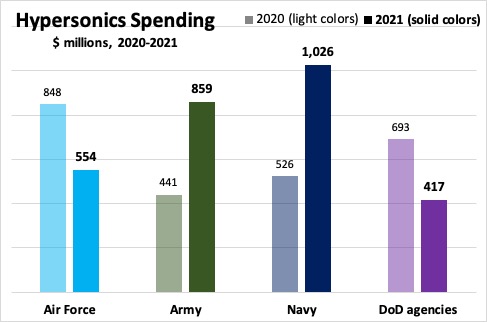
Army and Navy hypersonics spending would nearly double in 2021. Each increases by 95 percent. But that's offset by a 40 percent reduction in spending by independent defense agencies like DARPA, which are handing off much of the work to the services as programs move from basic research to prototyping, and a 35 percent cut in the Air Force, which cancelled one of its two major hypersonics programs.

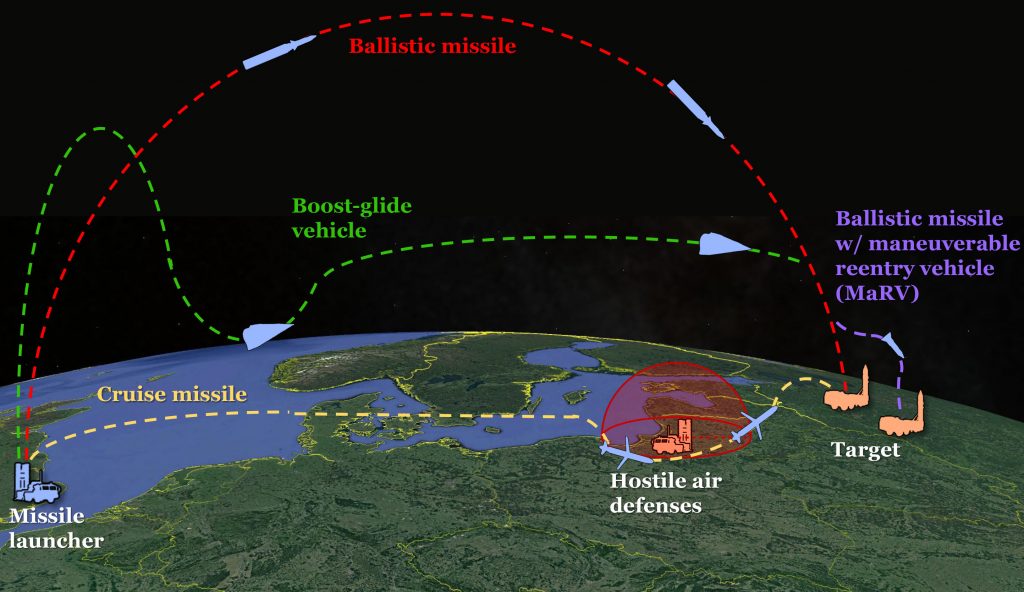
Hypersonic weapons fall into two main categories. The more conservative approach — relatively speaking, since these are all bleeding-edge weapons — is known as boost-glide, because it uses a conventional rocket booster to accelerate the weapon to hypersonic speed, after which the glide body containing the warhead detaches from the booster and coasts, skipping along the upper limits of the atmosphere like a stone across a pond. The Navy and Army programs are both boost-glide weapons, and the two services are using a common booster rocket, built by the Navy, and a Common Glide Body, built by the Army and lead contractor Dynetics. The Navy also plans to customize the weapon to launch from submarines, while the Army version will fire from trucks, a much simpler engineering challenge.
CSBA graphic

Notional flight paths of hypersonic boost-glide missiles, ballistic missiles, and cruise missiles. (CSBA graphic)

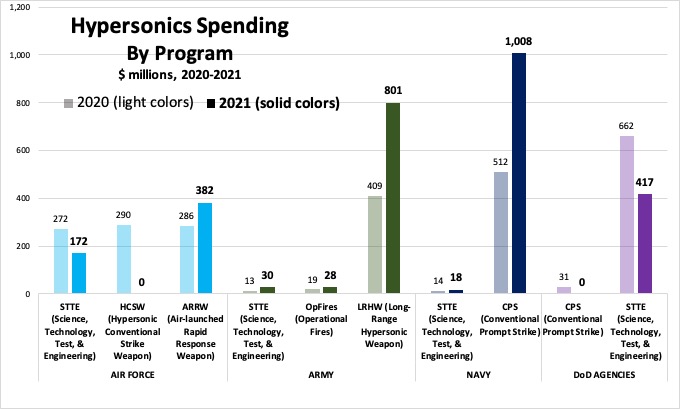
The Air Force had two boost-glide programs. HCSW (pronounced hacksaw), the Hypersonic Conventional Strike Weapon, which would have used a modified version of Army-built Common Glide Body. But the Air Force decided to cancel HCSW and focus its efforts on the more compact ARRW (arrow), the Air-launched Rapid Response Weapon. (Both HCSW and ARRW are Lockheed Martin programs).

Finally, DARPA is working on an alternative to boost-glide: air-breathing hypersonic cruise missiles that spend their entire flight in the atmosphere, with their engines providing continuous thrust. That allows the engine to take in oxygen from the air as it flies, rather carrying bulky oxygen tanks — as a boost-glide weapon's rocket boosters do. But flying through the atmosphere also creates friction, heating up an air-breathing hypersonic weapon in ways a boost-glide design, which spends most of its time in a near-vacuum, doesn't have to worry about.

Since the air-breathing technology is more ambitious, it remains a DARPA effort for now, with two contracts: Northrup Grumman and Raytheon are working on the Hypersonic Air-Breathing Weapons Concept (HAWC) and Lockheed Martin on the Hypersonic Strike Weapon air-breathing (HSW-ab). While these programs will probably transition to the Air Force in the near future, they don't yet have their own budget lines in the documents we obtained; they're almost certainly folded into the figure for independent defense agencies.
Sydney J. Freedberg Jr. graphic from DoD data

Breaking Defense graphic from DoD data

The documents summed up a portfolio of programs the Pentagon now refers to as “missile defense and defeat,” a euphemism which combines offensive and defensive programs. As Breaking D readers know, DoD has taken to lumping long-range strike efforts known as left-of-launch into its budget reporting on missile defense, with a total of $3.26 billion included for such activities in the 2021 request. Spending on hypersonic weapons is listed as a subcategory of “nontraditional” missile defense funding, defined as:

funding for missile defeat efforts outside of the above missile defense efforts. This captures ‘left-of launch' efforts that defeat missiles before they take flight via high-speed strike (e.g. Conventional Prompt Strike) or cyber-attack operations.

We combed through the document to extract the offensive hypersonics programs from traditional missile defense, directed energy (lasers), cyber warfare, and other means of neutralizing enemy missile salvos.

The document broke down 2020 funding and 2021 requests for Army, Navy, Air Force and defense-wide, both for foundational science, technology, test and evaluation (STTE) as well as for each individual service's programs to develop hypersonic missiles. Meanwhile, the Missile Defense Agency and the Space Development Agency are working on a space-based sensor to detect adversary hypersonic and cruise missiles, under the Hypersonic & Ballistic Tracking Space Sensor (HBTSS) Prototyping program.

The Navy is the big spender in 2021, with the bulk of the funds slated for the Conventional Prompt Strike (CPS), a submarine-launched boost-glide weapon set to enter service in 2025. Its total hypersonic budget in 2020 is set at $526 million, but jumping to just over $1 billion in the 2021 request. (DoD agencies spent $31 million in 2020 wrapping up their portion of CPS, but the whole program will be in the Navy budget as of 2021).

The Air Force's 2020 budget includes $848 million, the budget documents show, but that drops in the 2021 request to $554 million due to the cancellation of HCSW. The Air-launched Rapid Response Weapon (ARRW) is funded at $286 million in 2020 and the service is asking for $382 million in 2021.

As for the Army, the documents put 2020 spending at $441 million, and the 2021 request is for $859 million. That increase is driven by a big jump in the budget for the land-based version of the common Army-Navy boost-glide weapon, the Long Range Hypersonic Weapon (LRHW), from $409 million in 2020 to $801 million in 2021.

(This LRHW line item also includes some work on the cancelled Mobile Intermediate Range Missile. DoD never said publicly what MIRM would be, or even whether it would be a hypersonic missile or a conventional ballistic missile, and it appears to have been stillborn).

The documents also show the Army spending $19 million on the Operational Fires ground-launched hypersonic missile program in 2020, and asking for another $28 million in 2021. OpFires is a joint program with DARPA. Lockheed Martin scored a $31.9 million contract from DARPA in January to begin Phase 3 Weapon System Integration under the program.

https://breakingdefense.com/2020/04/exclusive-dod-asks-2-9b-for-hypersonics-in-2021

Sur le même sujet

  • United Technologies awarded $762.5M for Air Force, Marine Corps F-35 engines

    25 novembre 2019 | International, Aérospatial

    United Technologies awarded $762.5M for Air Force, Marine Corps F-35 engines

    ByChristen McCurdy Nov. 22 (UPI) -- United Technologies has received a $762.5 million contract modification to deliver F135 propulsion systems for the Air Force and Marine Corps. The new deal, announced Thursday by the Department of Defense, funds Lot 14 production and delivery of 48 F135-PW-100 propulsion systems for the Air Force and 10 F135-PW-600 propulsion systems for the Marine Corps. The Pratt & Whitney F135 is a turbofan engine for the Lockheed Martin F-35 Lightning II, fifth generation single-engine stealth fighters used the Air Force, Marines and Navy plan to replace much of their fleets with in future years. In October, Lockheed finalized a $34 billion deal with the Pentagon to deliver 478 F-35 fighter planes in production Lots 12, 13 and 14 at a cost below $80 million each. It's the largest contract in military history, and the lowest per-plane cost for the F-35 series yet. That deal came after pressure from the Pentagon to lower the per-plane cost of the aircraft, which has also faced scrutiny for production and safety issues. The new contract funds production of 48 F135-PW-100 engines for the US Air Force. The F135-PW-100 powers the Air Force's F-35A aircraft. Per the October deal, the Pentagon's expected cost per plane for the F-35A in Lot 14 in $77.9 million. The deal also funds 10 F135-PW-600 engines for the Marine Corps' F-35B. Lot 14 production F-35Bs are projected to cost $101.3 million per plane. The Pentagon has obligated fiscal 2020 aircraft procurement funds in the amount of $762 million -- it covers $521.5 million in purchases for the Air Force and $240.9 in Marine Corps. The bulk of work will be performed in East Hartford, Connecticut, with some work taking place in Indianapolis and Bristol, England. https://www.upi.com/Defense-News/2019/11/22/United-Technologies-awarded-7625M-for-Air-Force-Marine-Corps-F-35-engines

  • Army releases $1B cyber training request

    15 juin 2020 | International, C4ISR, Sécurité

    Army releases $1B cyber training request

    Mark Pomerleau The Army released its highly anticipated request for proposals June 11 for a contract that could be worth as much as $1 billion to provide cyber training for the Department of Defense. The Cyber Training, Readiness, Integration, Delivery and Enterprise Technology (TRIDENT) is a contract vehicle to offer a more streamlined approach for procuring the military's cyber training capabilities. The Army is running the contract on behalf of the joint force. The largest part of that contact will be the Persistent Cyber Training Environment (PCTE). PCTE is an online client in which members of U.S. Cyber Command's cyber mission force can log on from anywhere in the world for training and to rehearse missions. Cyber Command leaders have said this element is one of the organization's most critical needs. Currently, no integrated or robust cyber training environment exists. To date, two companies have announced their teams that will be pursuing the contract. ManTech and General Dynamics announced late last year they are joining forces to compete for the opportunity. Raytheon announced at the end of April that it will also compete for the contract. In its announcement, it said it is partnering with Red Hat and VMware. Responses are due Aug. 6. https://www.fifthdomain.com/dod/cybercom/2020/06/12/army-releases-1b-cyber-training-request/

  • Replacing the Bradley is the top priority for the Army’s next-gen combat vehicle modernization team

    9 octobre 2018 | International, Terrestre

    Replacing the Bradley is the top priority for the Army’s next-gen combat vehicle modernization team

    By: Jen Judson WASHINGTON — The modernization team tasked with advancing the Army's next-generation combat vehicles is focused, as its top priority, on replacing the Bradley Fighting Vehicle with an Optionally Manned Fighting Vehicle, according to the team's leader, Brig. Gen. Ross Coffman. The OMFV is meant to “provide options to commanders in combat, so it's a decision to, manned or unmanned, gain contact with the enemy, and that can be visual or through firepower, and it actually provides options to commanders so that they can use the best way to accomplish their mission,” Coffman said in an interview with Defense News shortly before the Association of the United States Army's annual meeting. The Next-Generation Combat Vehicle Cross-Functional Team — established as part of the Army's new Futures Command — tackles the service's second highest priority out of six major lines of effort that are intended to fully modernize the force by 2028. The CFT has had many conversations with industry to determine what's possible. The team has laid out what it thinks will be the requirements for the vehicle, Coffman said, including aspects like an optionally manned capability, loading it on a C-17 aircraft, protection elements and lethality. Even though the Army plans to rapidly prototype and procure the OMFV, Coffman said the team will continue to roll new technologies in through constant experimentation, in parallel with OMFV procurement, so that the first OMFV that comes out and gets fielded is constantly improved. The Army will roll those improvements into manufacturing “so that we can always maintain the current technology on these vehicles,” he said. The Army is requesting that designs have lots of room for upgrades and to add in new technology. "We know technology will continue to move at the pace it is today or faster, and it is going to allow us to have enough physical space and computing power as well as propulsion power that, if we want to add things to these vehicles, we have the ability to build them [to be] the best they can be,” Coffman said. Jumping right in, the service plans to release a request for proposals, not just a draft, by the end of the year, Coffman said. It is anticipated that the proposals will be due in May next year, and then the Army will downselect to two competitors who will build 14 prototypes in an engineering and manufacturing development phase in the first quarter of fiscal 2020, according to industry sources. Coffman said he hoped to cast a wide net with industry, including looking to partners around the world for solutions. “We want them to bring us their best, and we will evaluate and downselect to some number and do a procurement contract at the end of the final evaluation,” he said. To accommodate for the OMFV effort and the other lines of development within the CFT's portfolio, the Army has downgraded its prototype activity within the Army's Tank Automotive Research, Development and Engineering Center. A year ago, the Army had kicked off a major prototyping effort to develop what the service was calling its NGCV by awarding an industry team a contract to build two demonstrators by fiscal year 2022. The Army awarded a seven-year, $700 million contract to a team consisting of SAIC — the team lead — as well as Lockheed Martin, Moog Inc., GS Engineering Inc., Hodges Transportation Inc. and Roush Industries. Jim Scanlon, senior vice president and general manager of SAIC's Defense Systems Group, told Defense News in a recent interview that while the initial plan was to build prototypes, the strategy has evolved. Now, the team is working on sub-system experimentation for TARDEC using Bradley assets, to test capabilities such as mobility systems and manned-unmanned teaming. SAIC, according to Scanlon, sees the Mobile Protected Firepower solution it is hoping to prototype for the Army as possessing technological capabilities that will serve as “hooks” — or a pathway — to fulfilling OMFV requirements. Other companies are likely to emerge with offerings for OMFV, including General Dynamics Land Systems, AM General and BAE Systems. BAE Systems brought its CV90 fighting vehicle, developed for the Swedish army, to AUSA. The Netherlands, Finland and Denmark are also customers of the vehicle. According to BAE, it brought the CV90 to the show as a starting point to discuss possible options for the NGCV program. Raytheon and Rheinmetall announced at the AUSA conference Oct. 8 that they are partnering to provide Rheinmetall's Lynx combat vehicle as its submission to the impending OMFV competition. https://www.defensenews.com/digital-show-dailies/ausa/2018/10/08/replacing-the-bradley-is-the-top-priority-for-the-armys-next-gen-combat-vehicle-modernization-team

Toutes les nouvelles