16 novembre 2022 | International, Aérospatial
Can the Air Force train new pilots without planes?
Goodbye, T-1 Jayhawk. Hello, simulators.
29 janvier 2020 | International, Aérospatial
Lockheed Martin opens up its F-35 production facility to provide an update on its fifth generation fighter program
On July 23, 2019, Canada released the formal Request for Proposals to eligible fighter aircraft suppliers. Suppliers now have until early 2020 to submit their proposals. As we go to press, there appears to be three contenders for Canada's Future Fighter Capability Project (FFCP): Boeing (Super Hornet); Lockheed Martin (F-35 Lightning II) and Saab (Gripen). A target date of March 31, 2020, has been set for phase three of the FFCP to conclude, before moving on to phase four (Implementation and Contract Award) in 2022. Aircraft deliveries are to begin in 2025, and the aircraft chosen is anticipated to be in operation through 2060.
What is Canada seeking? Canada's defence policy, Strong, Secure, Engaged, (SSE) outlines, “In order to counter today's evolving threat environment, and remain highly interoperable with its allies and key operational partners, Canada will procure a fighter capability of 88 jets to replace the aging CF-18 fleet.” Key elements of this statement seem to be: an evolving threat; highly interoperable; and an aging fleet.
The SSE policy cites advanced fighters, anti-access area denial (A2AD) surface-to-air missile systems and evolving cyber threats as constituting aspects of the “evolving environment” within which the Canadian Armed Forces is expected to operate. Specific attributes of a future fighter include being “capable, upgradeable, resilient and interoperable with our allies and partners to ensure Canada continues to meet its NORAD and NATO commitments in the future.” The mission set envisaged for Canada's future fighter involves enforcing Canada's sovereignty, enabling continental security, and contributing to international peace and stability.
Controlling Canada's vast airspace is paramount, “while maintaining an ability to simultaneously contribute to international operations, conduct pilot training, and to allow for maintenance and repair.” Acquisition of a future fighter is to include “associated equipment, weapons, and sustainment set-up and services to ensure an uninterrupted Canadian Fighter capability that leverages Canadian industry capabilities and contributes to economic growth and jobs.” Throughout this important process, and beyond, “Canada will continue to engage with stakeholders on advancing industrial and technological benefits for companies in Canada, and promoting innovation, ensuring best value and supporting Canada's defence priorities.” In summary, “Canada will seek, through negotiations, commitments from industry that align with the Value Proposition (VP) strategic objectives.” What are these Value Proposition strategic objectives?
Value for Canada
Commenting on possible elements of the value proposition seems possible, mindful of the most basic description of a value proposition as something that helps us avoid pain while also securing some sort of gain. The strategic objectives, on the other hand, are more difficult to ascertain. Exploring these ideas is helpful, when it comes to evaluating the (present) three contenders for the FFCP.
A February 2014 article on Canada's Defence Procurement Strategy (DPS) seems helpful. According to the DPS there are three primary elements: “The Industrial and Technological Benefits program (ITB) to improve economic returns to Canada from defence purchases; a defence exports strategy; and new institutions and processes to improve governance and streamline defence acquisitions. Prime contractors on major Crown projects need to provide the government with detailed industrial plans on how their bid will benefit Canada's economy in terms of exports, R&D, supply chain development for small- and medium-sized Canadian companies and defence sector growth. These value propositions to Canada will be rated and weighted in bid evaluations. Since the Guide's release, we have seen nascent value propositions being applied.”
Further review of SSE provides more clues: Gains include advanced capabilities; maintaining an advantage over potential adversaries; and keeping pace with our Allies. These are some of the gains that flow from another: Namely, “fully leveraging defence innovation and technology.” The SSE also seems to stipulate the importance of “streamlined and flexible procurement arrangements”. This latest one speaks to a major pain the Department of National Defence has been struggling with, of late; specifically, an inability to spend as much as $2 billion in capital funds, each year for the past few years. The SSE also stresses the “unpredictable and complex” nature of the security environment. In response, the RCAF is in need of solutions which “integrate Command and Control, Communications, Computers, Intelligence, Surveillance and Reconnaissance and operational and long-term target setting and support within a Five Eyes environment.”
In early November, a Canadian media contingent traveled to Fort Worth, Texas, and to Phoenix, Arizona. The purpose of the visit was to learn from the F-35 Lightning II manufacturer the status of their 5th generation fighter program. The visit also provided an opportunity to speak to F-35 operators within the United States Air Force at Luke Air Force Base, home to an important flight training facility. In late August of this year, Valerie Insinna of the New York Times Magazine, wrote, “The first batch [of F-35s] cost US$241.2 million per plane. In June of this year, Lockheed and the Pentagon announced the price of the F-35A [would soon] drop to the US$80 million [level].”
During the media visit to Ft Worth, a briefing by Lockheed Martin officials confirmed Insinna's discussion point, revealing the cost of an F-35 has indeed fallen to US$77.9 million. There are many reasons for this positive outcome, some to be expected, others to be praised even more so. In terms of the expected, Walter Kiechel III writes in his book, The Lords of Strategy, “...as early as 1925, manufacturers of aircraft had begun to observe that the amount of labour that went into making an aircraft declined predictably as the number of planes manufactured increased. Typically, the fourth plane took only 80 per cent of the labour required to make the second, the eighth only 80 per cent of what had gone into the fourth.”
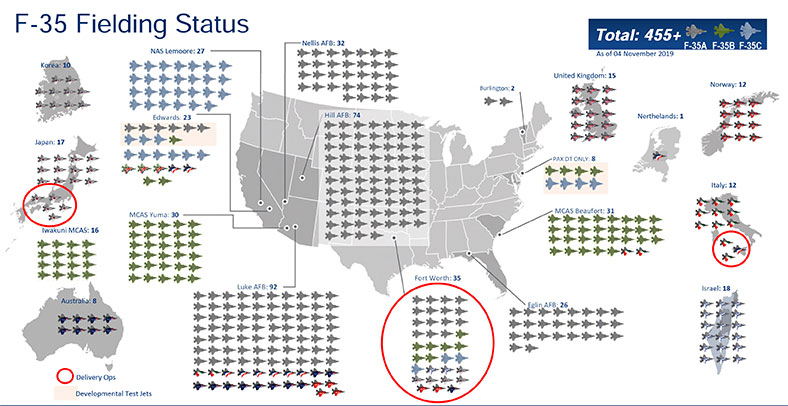
More than 455 F-35 Lightning II aircraft have now been delivered to 20 bases, 13 customers and nine nations, around the world . Eight services, including the USAF, US Navy and the United States Marine Corp (USMC), have declared Initial Operational Capability (IOC), with over 230,000 flying hours amassed on the airframes thus far. The number of pilots trained now exceeds 955, while more than 8,475 maintenance personnel are now qualified on the F-35 program. It is to be noted that the USAF, the United States Marine Corps, the United Kingdom's Royal Air Force (RAF) and the Israeli Air Force all have also flown into combat with the F-35.
Expansion of the F-35 to more than 30 bases is underway, with more than 860 aircraft expected to be delivered by 2022. More importantly, the network of users and supply locations is growing quickly, which bodes well for current and future users of the aircraft, mindful of the fact the security environment can require them to operate their fleet anywhere the need arises. As utilization of the F-35 expands, around the world, so to do sources of expertise, maintenance, sustainment and supplies. This unified endeavour – nine nations and growing – from a sustainment perspective raises the possibility of improved networking at falling costs.
As more aircraft reach the line, and as more hours are put on the growing number of airframes, Lockheed Martin's maintenance and sustainability experience is growing seemingly in leaps and bounds. This part of the manufacturer's program is also reaping dividends. Condition-based maintenance is a user-focused capability built-in to the system, to allow the user greater control over when to take an airframe off the line before break down can be expected. Air Forces understand unscheduled maintenance is what drives manpower demands; consequently, the condition-based maintenance capability helps air forces better manage manpower much more effectively, when it comes to fighter aircraft maintenance.
Canadian contributions to the manufacture of the F-35 are numerous. More than 20 Canadian firms are providing key elements of the Lightning II, but the number of domestic firms contributing to the F-35 is much higher. For example, Magellan Aerospace supplies parts for the horizontal tail, and other parts for the armaments bay. Canadian expertise in composite parts, locking mechanisms, lighting, circuit boards, navigation aids, electronic warfare capabilities and engine health monitoring systems contributes to the F-35's growing capabilities.
Current projections see US$80 million at most for each jet, an 80 per cent and higher mission capable rate and up to US$25,000 operating expense per flight hour, as a goal by 2025. Canada's F-35 “Program of Record” involves 88 aircraft, 110-plus Canadian companies contributing to the manufacturing process; thousands of jobs and more than US$1.5 billion in contracts over the life of the entire F-35 program. Canada has extended the EBA or economics benefits agreement, as an important framework to consider by those crafting a value proposition for the FFCP.
Sustainment is designed right into the airframe, but, as with some of F-35's remarkable operational capabilities, these sustainment attributes are one of those things you cannot really see. The F-35 also holds unique design characteristics not seen on previous fighter aircraft. For example, the canopy is unusual in that it is hinged at the front, not the rear. Doing so provided a lighter moment-arm, meaning the motor can be smaller, and this means the motor lasts longer. Since the canopy opens toward the front, it does not have to be removed when removal of the ejection seat is needed. These and other non-traditional designs have cut significant sustainment hours traditionally much higher on the F-35s predecessors. For example, removing a rear-opening canopy, so as to remove the ejection seat, typically takes more than three hours on other aircraft. Another example of a unique time-saving design involves the use of pneumatics.
Traditional aircraft have used explosive shells to aid in dropping armaments and fuel tanks, etc. However, since the F-35 uses pneumatics (air pressure) all the maintenance-personnel-hours required to clean up (brush parts) explosive shell remnants on aircraft parts are a thing of the past. Additionally, the vast majority of Line-replacement units (LRUs) – as many as 95 per cent – are 1st-tier removable. No longer is there any need to remove 1st- and 2nd- tier LRU boxes to get at the 3rd- tier boxes in behind all the others. This save an enormous amount of time. Furthermore, 86 per cent of the boxes are hidden behind Low Observability (LO) panels that do not require restoration, afterwards. When it comes to LO restoration, on the F-35, those trained for this critical work have declared the aircraft is much less demanding when it comes to the LO restoration needs experienced with the F-117, B-2 and the F-22. Lockheed Martin leaders readily quip that the LO shop at Eglin Air Force Base has the best volleyball team on the base.
During the visit to Luke AFB, our media representatives saw first-hand the F-35/USAF sustainment tool known as Autonomic Logistics Information System (ALIS) being put to good use. The ALIS is at the heart of the F-35s promising reduced maintenance demands. The ALIS is referred to as a “sustainment tool” which is engineered alongside the F-35 offering efficiencies and greater cost effectiveness. High fidelity information about the F-35 fleet is tracked within ALIS to help reduce operations and maintenance costs and increase aircraft availability. “ALIS turns data from many sources into actionable information, enabling pilots, maintainers and military leaders to make proactive decisions to keep jets flying.”
A review of fuel tank checks is a case-in-point. On the F-15 and the F-16 up to six maintenance personnel were required to conduct routine checks on the fuel tanks and valves. With the F-35 only one technician is needed. The engine need not run, as the technician can perform all of the checks using one laptop and one button. With strict reference to aircraft maintenance labour tasks, maintenance technician numbers may be reduced from ten to three personnel per aircraft. Such a reduction makes no consideration of operating conditions and mission-objectives, lest anyone think to reduce personnel numbers without carefully considering other factors unique to your own air force.
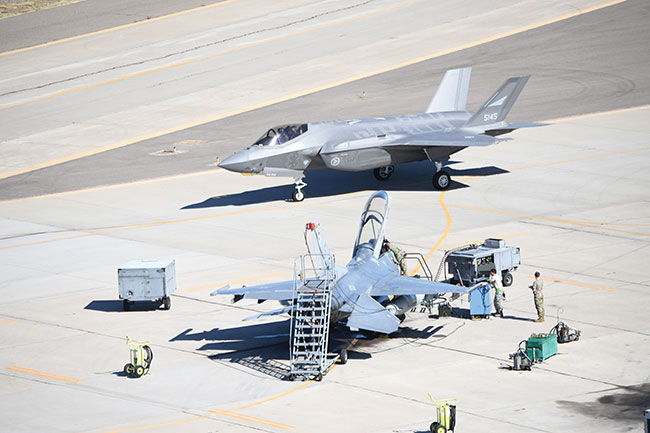
Maintenance developments
In addition to learning more about the F-35 in operations, our media visit participants learned about some very innovative maintenance developments: B.O.L.T.; and L.I.T.T. The BOLT program combines maintenance-specific Air Force specialty codes, essentially job descriptions, into two career tracks. Maintainers in the air vehicle track are crew chiefs, fuels and low observable technicians. Airmen in the mission systems track focus on avionics, weapons and egress. This training allows a single Airman to perform multiple inspections and do the associated work required in areas where they are qualified. They don't have to wait for qualified Airmen from other specialties to complete inspections or any required fixes on the aircraft.
“The BOLT Airmen who are here with us offer widespread benefit. They will allow us to deploy the same aircraft with a smaller number of Airmen than we would at home station,” said Col. Michael Miles, 388th Maintenance Group commander. “This is a new way to train our Airmen to be more operationally focused and that ties directly to the primary mission sets of the F-35A.” The goal of the BOLT program is less down time, more productivity and a smaller maintenance footprint required for each jet. Reducing the size of the maintenance force allows commanders more combat flexibility for quickly deploying a small number of aircraft to a remote airfield with fewer Airmen.
Secondly, we also learned about a 2018 Luke Air Force Base initiative to increase F-35A Lightning II maintenance efficiency through the creation of a team of unified maintenance specialties called Lightning Integrated Technicians, which has expanded. Maintainers from independent career fields, including crew chiefs, avionics, weapons and low-observable technicians, who operate separately in traditional maintenance, were integrated into a single coordinated team using cross utilization training and shared work procedures. Senior enlisted members initially created a 1,225-task Career Field Education Training Plan, consisting of all core tasks derived from the four included career fields.
Leadership has consolidated these tasks to a 258-task CFETP and a total job listing of approximately 900 core maintenance procedures that the LIT members should be able to perform. In the past, sections performed career-specific tasks with minimal coordination with other sections, however, LIT team members work consistently on the same jet, making it easier for them to track and plan all maintenance performed. “One of the biggest challenges pilots face is continuity of operations. Whether it's a stable turn pattern, predictably reliable aircraft, or upcoming training phases – our success depends on the trust that our maintainers deliver safe and operational aircraft,” said Lt. Col. Peter Lee, 62nd Fighter Squadron commander.
“The LIT concept has helped our maintainers see the continuity of the jet they're assigned to not just as a dedicated crew chief, but as a team responsible for that jet.”
In terms of flying the F-35, the aircraft's break from the traditional fighter capabilities was evident in the discourse offered by pilots who have amassed hundreds of flying hours. To understand the significant differences between the 5th generation F-35, and its 4th (and older) generation counterparts, we were encouraged to consider the impact of low observability technology, on tactics, and the benefits of all the various intelligence-surveillance-reconnaissance (ISR) sensors and other equipment all built right into the airframe.
The F-35 Lightning II employs “nose-to-tail” low observability (LO) processes and technology. Embedding antennas into the skin, for example, is the kind of design feature that makes it quite a challenge for even other 5th generation fighters to detect the F-35. Additionally, the Active Electronically Scanned Array (AESA) radar early types of which introduced with some 4th generation aircraft, is a significant capability of the F-35. This capability is comparable to Airborne Early Warning and Control (AWACs) capabilities offered by other aircraft, previously, but in the F-35 the AESA radar does not present a “radar return” to the pilot, as did previous generation (2nd and 3rd) generation fighters. Instead, “...on the F-35 targets are presented to the pilot, who then places the cursor over top of the presented target(s) and the display reveals how many of and which sensors are contributing to that presentation, not just from that particular pilot's aircraft but from all the other networked assets to which the pilot's aircraft is linked.”
From a defense perspective, the ability to deploy a low-observable, networked sensor output-capable, 5th generation fighter like the F-35 is itself a significant deterrence. It messes with the enemy commander's efforts to develop strategy and tactics, because the situation is much less clear to that commander than would otherwise be the case. It forces the enemy to honour the likelihood you are there, even though you are undetectable. It forces the enemy commander to accept you probably already know what they are planning, thinking and capable of, all the while you have done so without showing yourself, and without revealing who might be with you.
These are the elements of an evolving operational effectiveness that may be drawn from use of the F-35. In the mid-1980s, deployments to NATO's north flank with the Allied Command Europe Mobile Force (Land) (AMF(L)) involved commanders who believed the best deterrence came not from hiding assets under camouflage nets, or deep in the forests of northern Norway. No; instead, commanders demanded deterrence come from flying all our flags, dismantling camouflage nets and parking all our assets out in the open, for the enemy to see. Today, the security environment is significantly different, far more complex. The essential requirement to work through strategist John Boyd's Observe-Orient-Decide-Act loop faster than the enemy can, in the field, benefits from remaining undetected, for as long as possible. Stealth, from nose-to-tail low-observability, is the key. | W

16 novembre 2022 | International, Aérospatial
Goodbye, T-1 Jayhawk. Hello, simulators.
30 novembre 2018 | International,
Flying at 50,000 feet, diving deep in the ocean, or hiking for miles with gear through extreme climates, military service members face conditions that place unique burdens on their individual physiology. The potential exists to develop pharmacological interventions to help service members complete their toughest missions more safely and efficiently, and then recover more quickly and without adverse effects, but those interventions must work on complex physiological systems in the human body. They will not be realized under the prevailing system of drug discovery and development with its focus on engaging single molecular targets. DARPA created the Panacea program to pursue the means of rapidly discovering, designing, and validating new, multi-target drugs that work with the body's complexity to better support the physiological resilience and recovery of military service members. The premise of Panacea is that the physiological systems of the human body work in complex and highly integrated ways. Drugs exert effects on our bodies by physically interacting with and changing the functional state of biomolecules that govern the functions of cells and tissues. Most drugs target proteins, which are the principle cellular workhorses. Ideally, drugs would target multiple proteins simultaneously to exert precise, network-level effects. One major problem facing the drug development community is that the functional proteome — the complete collection of proteins and their roles in signaling networks — is largely dark to science. Despite being able to identify many of the proteins within a cell, researchers do not have a firm grasp on everything those proteins do and how they interact to affect physiology. Due to this sparsity of structural and functional knowledge, the state of the art in drug development — what Panacea seeks to transform — is to engage only a very small fraction of known protein targets to achieve an effect. In fact, today's approach to drug design singles out individual proteins in certain cells. That hyper-specificity is an attempt to minimize the risk of side effects and speed time to market, but it also yields a thin stream of drugs, many of which have similar mechanisms and relatively muted effectiveness compared to what might be achieved using a multi-target, systems-based approach. “The current roster of drugs approved by the U.S. Food and Drug Administration only targets about 549 proteins, yet the body can produce more than six million different protein variants,” said Tristan McClure-Begley, the Panacea program manager. “The opportunity space for pharmacological intervention is vast and effectively untapped, but to access it we need new technology for understanding and targeting the human functional proteome.” Panacea will address the lack of functional knowledge about the proteome. DARPA's call to the research community is to consider complex physiological conditions relevant to military service members — for instance, metabolic stress during extreme endurance missions or pain and inflammation after injury; investigate the molecular mechanisms underlying those conditions; identify multiple, key molecular targets involved; and develop novel medicinal chemistry approaches to synthesize interventions that modulate those targets. DARPA believes that multi-target drugs will deliver safer and more efficacious solutions to military requirements for readiness and recovery over state-of-the-art interventions. “Many of the most successful drugs produced in the past were found rather than made, and we knew what they did long before we knew how they did it,” McClure-Begley said. “To deliver improved interventions, we need to get to a place where we can investigate all of the potential proteins at play for a given condition and then prioritize sets of protein targets and signaling networks to effectively modulate physiological systems, regardless of what prior knowledge exists about those targets.” The Panacea program aims to generate initial proof of concept for this new direction in drug discovery and development. Research will primarily involve animal models, human cell derived organoids, and high-throughput cell culture models. However, to support eventual transition to humans, DARPA will work with federal agencies to develop a regulatory pathway for future medical use. By the end of the five-year program, DARPA will require teams to submit novel drug candidates to the U.S. Food and Drug Administration for review as an Investigational New Drug or for Compassionate Use. DARPA will hold a Proposers Day on December 14, 2018, in Arlington, Virginia, to provide more information about Panacea and answer questions from potential proposers. For details of the event, including registration requirements, visit https://go.usa.gov/xP6hD. A forthcoming Broad Agency Announcement will fully describe the program structure and objectives. https://www.darpa.mil/news-events/2018-11-28
6 mars 2020 | International, C4ISR
Canberra, Australia, March 5, 2020 -- Viasat Inc. (NASDAQ: VSAT), a global communications company, today announced it signed a Strategic Alliance Agreement (SAA) with Blacktree Technology, Pty Ltd (Blacktree), an Australian-based communications systems design and integration company, in November 2019. The SAA will enable Viasat and Blacktree to meet the needs of the Australian Defence Force (ADF) requirements, by providing rapid and cost-effective in-country manufacturing and support services for Ultra High Frequency (UHF) satellite communications (SATCOM) systems. Colin Cooper, general manager, Government Systems, Viasat Australia commented, “Our agreement with Blacktree will play a critical role in supporting and expanding UHF support and maintenance resources in Australia, and will provide opportunities to investigate export of UHF products and services to Five Eyes (FVEY) and coalition UHF military SATCOM user nations.” “Blacktree welcomes the formalisation of the alliance with Viasat, which strengthens a relationship that enhances ongoing innovation and development of UHF SATCOM solutions and support for Defence customers in Australia and internationally,” said Joe Nevin, director, Blacktree Technology. Viasat's leadership in critical technology segments such as SATCOM, tactical networks and cybersecurity offers an opportunity for Australia to modernise systems used by the ADF. Viasat is a leader in UHF SATCOM and is working to assure global 25-kHz Demand-Assigned Multiple-Access and next-generation Integrated Waveform (IW) networks and services, enabled by Viasat's Visual Integrated Satellite communications Information, Operation and Networking (VISION) software platform continue to meet military mission requirements. Viasat's Ka-band broadband satellites combined currently offer more bandwidth than any other satellite operator in the world. Viasat is a vertically integrated satellite communications technology and services company, and is a leading provider of highly integrated GEO payloads, components & subsystems, gateway/teleport antenna systems, networking systems, user terminals for fixed & mobile applications, ASICs, MMICS, and/or modules for third party terminal developers. Importantly from a defence perspective, beginning in 2021, Viasat plans to launch a new, global ViaSat-3 constellation of resilient, flexible and agile high-capacity communications satellites that will improve responsiveness of current and emergent defence mission threats. Viasat's Australian Government Systems business is headquartered in Canberra and provides a wide range of defence technology capabilities and sovereign resources to meet Australia's needs. The range of products being developed and supported by Blacktree include high-gain UHF helical antenna's, static and remote-control pedestal systems, filters and diplexers, HPA's, LNA's and RF management components. Blacktree's products are manufactured in Perth, complemented by support teams located in Darwin and Canberra, Australia. About Viasat Viasat is a global communications company that believes everyone and everything in the world can be connected. For more than 30 years, Viasat has helped shape how consumers, businesses, governments and militaries around the world communicate. Today, the Company is developing the ultimate global communications network to power high-quality, secure, affordable, fast connections to impact people's lives anywhere they are—on the ground, in the air or at sea. To learn more about Viasat, visit: www.viasat.com , go to Viasat's Corporate Blog, or follow the Company on social media at: Facebook, Instagram, LinkedIn, Twitter or YouTube. About Blacktree Technology Blacktree Technology is a trusted global supplier of critical communications solutions. For the past 20 years Blacktree has been solving communication problems in challenging and geographically diverse environments for commercial, industrial and Defence customers. Based on the west coast of Australia, the Company is supporting the ADF whilst growing exports to customers in FVEY partner nations. To learn more about Blacktree Technology, visit www.blacktree.com.au, or follow the Company on social media at Linkedin. Forward-Looking Statements This press release contains forward-looking statements that are subject to the safe harbors created under the Securities Act of 1933 and the Securities Exchange Act of 1934. Forward-looking statements include statements that refer to the strategic alliance agreement between Viasat and Blacktree Technology, including the provision of UHF SATCOM systems manufacturing and support services to the ADF, FVEY and coalition nations; and the performance, capabilities and anticipated benefits of the ViaSat-3 class satellite platform, including the expected capacity, coverage, flexibility and other features of the ViaSat-3 constellation. Readers are cautioned that actual results could differ materially and adversely from those expressed in any forward-looking statements. Factors that could cause actual results to differ include: the ability to realize the anticipated benefits of the ViaSat-3 satellite platform; unexpected expenses or delays related to the ViaSat-3 satellite platform; risks associated with the construction, launch and operation of ViaSat-3 and Viasat's other satellites, including the effect of any anomaly, operational failure or degradation in satellite performance; manufacturing issues or delays; contractual problems; regulatory issues; technologies not being developed according to anticipated schedules, or that do not perform according to expectations; and increased competition and other factors affecting the government and defence sectors generally. In addition, please refer to the risk factors contained in Viasat's SEC filings available at www.sec.gov, including Viasat's most recent Annual Report on Form 10-K and Quarterly Reports on Form 10-Q. Readers are cautioned not to place undue reliance on any forward-looking statements, which speak only as of the date on which they are made. Viasat undertakes no obligation to update or revise any forward-looking statements for any reason. Copyright © 2020 Viasat, Inc. All rights reserved. Viasat, the Viasat logo and the Viasat signal are registered trademarks of Viasat, Inc. All other product or company names mentioned are used for identification purposes only and may be trademarks of their respective owners. View source version on Viasat, Inc. : https://www.viasat.com/news/viasat-blacktree-technology-sign-agreement-enhance-support-australian-defence-force-and-five